by blogmistress on April 29, 2013
My daddy used to tell me to “plan your work and then work your plan.” In the ever-changing and face paced world of online marketing, that can be easier said than done. Often, it happens that a business decides to start building an online presence and then ends up with bits and pieces that don’t really fit together.
Bits and Pieces
Here is how that usually happens: A business owner creates a Facebook page (or perhaps not knowing any better, a Facebook profile) for their business. They start posting a few things and getting “likes” for their page. Now, they hear that Pinterest is the hot spot, soooo, they head on over and create a Pinterest profile and start pinning. Of course, you can’t get found online without including Google, so off they go to create a Google+ account. Now Google wants them to claim their place page and they are asking for a web address. Okay, now they have to bite the bullet and get a website (if they don’t already have one). Someone tells them (accurately) that a blog is good for search engine optimization. Oh, and what about pay-per-click? . . . this could go on and on forever.
Pull it together
If something like the above scenario is how things have happened for your business, it is time to stop and assess what you have and pull it all together in one overall plan. A good approach is to create a hub for your online presence and then build from there. The logical place to start building is with your website. It is really the only online property you own and who knows what the next hot social media site will be or how Facebook or Google are going to change their algorithms next. Think about:
- Who is your target market - who are you trying to reach?
- Where does your target market hang out? Are they on Facebook, Twitter or are they searching on Google for your products and services?
- Be where they are looking and link your accounts together to ultimately draw people back to your website.
- Create calls to action that will help your visitors convert into leads for your business.
- Have a plan for following up on the leads you have generated.
If you have bits and pieces out there that aren’t really tied together, the process of pulling it all together may take a bit of time and certainly some effort but it will pay off in the end with leads for your business.
Need help pulling it all together? Give us a call 504-491-0001.
by blogmistress on August 23, 2012
 “We have a website but we aren’t really getting any customers through our online channels.” This is something we hear all the time from business owners who are frustrated that they are not getting leads and customers from all of the time, money and effort that they put into their online presence.
What is interesting about this is that people are searching online and when they land on your site, they are actually looking to convert. They are looking to educate themselves to support a purchase decision. So what is the problem. In most cases, the problem is that there is no mechanism in place to allow for a conversion. If the only call to action on your site is “contact us,” you probably are not going to get a very high rate of people converting from visitors to leads and customers.
To support conversions, create compelling offers for people who are visiting your site. Your offer might be an educational whitepaper that gives them more information. It could be access to a coupon or free consultation. Think about what visitors to your website are looking for and give it to them through the form of an offer. Link your offer to a landing page with a form. If your offer is compelling and it is answering questions or solving problems that your visitor has, then they are more likely to fill out your form to get the information. Remember, they are looking to educate themselves to support a purchase. Once they fill out your form, they have converted into a lead! They have given you permission to give them more information.
Create offers and landing pages on your site and see what happens.
Need help? Call us at 870.404.1985 or email us at [email protected] to see how to get started. Also, download the Essential Guide to Internet Marketing to find out 8 essential steps to creating an online marketing strategy.

by Admin on August 20, 2012
Many businesses treat their websites as nothing more than Yellow Page ads. Remember the Yellow Pages… those yellow phonebooks you’d search through when you needed a plumber, auto mechanic or even a doctor (although doctors couldn’t have more than their name, address and phone number for the longest time). Businesses would buy the biggest ad they could afford. Some businesses even named their companies so they would so up first in the Yellow Pages (AAAA Insurance, for example).
Yellow Pages were very inefficient. They were only printed once a year. If your business started after the deadline for printing, you had to wait until next year. And a business could go out of business between the time they paid for an ad and when the Yellow Pages were printed. So, unlike websites, they could never quite be up to date.
Yellow Page ads are static and usually provide little more than a list of services or products the business offers, the address and phone number. Many businesses have websites that are nothing more than prettier versions of their Yellow Page ads. But websites can and should be much more.
A business website should be a dynamic, interactive lead/customer generating machine. After all, the ultimate goal of a business website is to get customers. A business website can do this by interacting with website visitors, prompting them to download eBooks and White Papers, and providing them with up to date information through a blog. This is all part of the Inbound Marketing Process which uses a business’s web presence to move web visitors down the Sales Funnel into leads and customers.
You can find out more about the Inbound Marketing Process on this blog or you can attend one of our upcoming webinars.
by blogmistress on July 16, 2012
 When people land on your website/Facebook page/Pinterest page, etc., what will they find? What is on your site that converts visitors into leads and customers? On every part of your web presence, you should be giving people an opportunity to become a lead or a customer. This is where CTAs (Calls to Action) come in.
There are different types of CTAs depending on where your visitor is in the sales process. For an ecommerce site, the CTA is easy- Buy Now. For other businesses, you may need a little more creativity. You may need to create offers that inform and nurture your visitors.
When you are creating CTAs, remember to always keep your visitors’ needs and desires in mind. Offer CTAs that inform and educate. Often, visitors are looking for information that will help them in their buying decision. You can create whitepapers and eBooks that are informative about your product or service that will educate your visitors. Perhaps, your visitors are looking for special offers. That is another great CTA. Offer a special deal for your visitors that they can’t get anywhere else. Not only is this effective for turning visitors into customers, it’s also a great way to track the effectiveness of your CTA.
What CTA can you create today that will convert your visitors into leads and customers for your business? Creating CTAs is an important part of inbound marketing that you cannot ignore if you want to be successful at internet marketing.
by blogmistress on July 9, 2012
 Monday is a great day to start improving your internet marketing to help your business. Here are three things you can do this week to help you attract more visitors, and convert them into leads and customers for your business.
- Identify new keywords – check out your analytics (you do have analytics for your site don’t you?). See what keywords people are using to find you and then brainstorm what words are working and what needs improvement. Use a keyword tool to see how many times those words are searched, and then optimize your site for those words.
- Create new blog posts. Blog posts are a perfect way to optimize for your newly identified keywords. Use the keywords in your post title and in your post as well. Use those keywords effectively so they can be ranked by search engines and make sense to your readers too. Provide useful information to your readers. This will help you attract more traffic.
- Now that you have optimized your posts and have attracted more traffic, you need to create a great call to action. What can you offer your visitors to convert them into leads for your business? Perhaps you can create an informative whitepaper or eBook. Maybe, you should offer a demo or a sample of your product. Be creative and come up with something that is useful and helpful to your visitors and that will get them engaged.
Okay, those are 3 easy steps that you can take this week to get started improving your internet marketing. Get started this week and then repeat these three steps each week and see what happens. What ideas do you have for improving your internet marketing this week?
Want some more ideas? Download the free eBook, Essential Guide to Internet Marketing today.
by Admin on February 28, 2012
Donʼt make the mistake of underestimating the importance of a compelling landing page. This is where you can see real results of your website redesign.
An effective landing page:
- Leaves out any website navigation.
- Keeps the description of the offer clear, simple, and concise.
- One company found that they had a 32% conversion rate with a longer description and form field. They cut it down, which brought their conversion rate to 53%.
- Keep the form above the fold.
To maximize efficiency, consider these questions:
- How fast can you launch a new landing page?
- Can one person do it in 15 minutes?
- What is the cost of experimentation?
Landing pages are where the magic happens. They are the gateway to your conversion offers that create engaged and interested leads. Make sure you can grab their attention with an interesting offer, but also coherently explain what you are offering through the landing page!
Download the free eBook: 7 Steps to Website Redesign Success to see some other vehicles for original content.

by Admin on January 4, 2012
As we start a new year, I thought I would list three ways you could increase the effectiveness of your website by increasing quality visits and conversions.
1) Improve your search engine optimization (SEO) by doing some Keyword Research
SEO is vital to your website being found for the right keywords in online searches. One of the best ways to improve your SEO is to do some Keyword Research.
When doing Keyword Research, you’ll want to research the terms that your potential customers might use to find you.
- Be careful not to use industry jargon (i.e. technical terms used by those in your industry) unless those are the terms your customers use.
- The terms your customers use to find you may change over time. For example, what we now call laptop computers have been called portable computers and notebook computers.
- Your main product or service may change over time.
So update your website to include the right Keywords.
2) Improve your website’s visibility by blogging
One of the best ways to increase quality visits to your website is by blogging. The simple rule is that the more content you have on the web, the better your chances of being found in search results. And there is no better way to increase your content on the web than by blogging. Be sure to include your Keywords in your blog posts and your blog posts’ names.
3) Place Calls to Action on your website
One of the best ways to convert website visitors into leads and customers is through the use of Calls to Action. A Call to Action is simply a directive to the website visitor (e.g. Click Here to download Free eBook). Often a Call to Action will offer the website visitor more information in exchange for their email address. Once you have an email address (a lead), you can set up a nurturing campaign where you send the lead more information about your product or service. (Always have an opt out option in your emails and stop your nurturing campaign if they opt out)
Of course, there are many more ways to improve your website. These are just three to help get you started.

by Admin on October 25, 2011
Does your website have a process for converting your website visitors into leads for your business? If it does, you are one of the lucky few because most websites today are glorified online brochures.
You see, in order to convert a website visitor into a lead, you must give the visitor a compelling reason to do so, such as a free white paper download offering more information. You do this through a call to action whereby the visitor gives you his name and email address in exchange for whatever you are offering. The problem with most websites is that their only call to action is the “contact us” form. The “contact us” call to action is the most common and least effective call to action. The reason it is not effective is because it offers no specific reason to take action. What will the website visitor get in return for contacting you? A sales pitch? That’s what they are thinking.
Most small business owners mistakenly believe their sales funnel is shorter than it really is. They believe that once somebody sees their beautiful website and reads how great they are, that person will pick up the phone and call them. Studies have shown that people who use the internet to research their purchases spend a lot of time researching before making person to person contact with a business. And the more expensive the product or service, the more time spent on online research.
Your website is a marketing tool. It should be generating leads for your business. If your website is basically a glorified brochure and your only call to action is contact us, maybe you should rethink the purpose of your website.
We use a software platform called HubSpot to help us generate leads through our website. If you’d like to learn how HubSpot can help your website generate leads for your business, click the button below.
by blogmistress on October 20, 2011
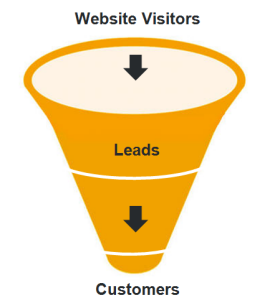 Is your website a static brochure or is it a lead generating machine? When people think about designing a website, or redesigning a website, they sometimes overlook the most obvious question which is, “Why?” Why do you want a website or a redesign? Often we hear that the reason is to get a “fresher look” or to incorporate new products or services. Sometimes, business owners want a redesign so they can make edits themselves. However, once they are able to make edits and add content, many times, the website still remains static and changes are seldom made.
What is missing here is the development of goals and strategies for your website. It is much easier to work on generating leads for your website when you have a plan in place. A lead generating plan for your website should start with some basics:
- What kind of content can I create on an ongoing basis that will attract visitors (and search engines) to my website?
- How will I research keywords that are necessary to include in my content?
- When people visit my website, what compelling calls to action can I offer that will encourage them to convert from a visitor into a lead?
- What different offers can I create for people who are in different places in the buying cycle?
- Once someone has converted to a lead for my business, how am I going to nurture that lead into a sale?
- How am I going to analyze my strategy in order to see what is effective and where I need to make adjustments?
All of these questions can help you start creating a strategy for turning your website into a lead generating machine.
Need help? Contact us and we can help you get started!

by Admin on October 19, 2011
 Content Is SEO King
We are constantly telling our clients that blogging is one of the best SEO strategies there is. That’s because search engines love content, fresh relevant content. And the best way to provide fresh relevant content is through relevant keyword rich blog posts.
As we are fond of saying on this blog, your website/blog is like a trotline with every page/post being a hook baited with relevant keywords (Google bait). The more pages/posts you have, the more hooks and Google bait you have. And the more likely you are to show up on a search results page.
Now What
So you’ve got your blog articles out there. Now one of them appears on the first page of someone’s search results and they click, go to and read your blog post. Now what?
What do you want them to do now?
- Download a White Paper or eBook
- Fill out a questionnaire
- Read another article
- Contact you for a consultation
- Or something else
Do you have a call to action that is relevant to your post or your business? Without a call to action, many, if not most, people will think nice article and continue searching the web for more information. You need to give them a reason to give you some information about themselves (e.g. name and email address) in return for something such as a white paper related to the blog post. Once you have their name and email information, they become a lead. Now you can use email marketing to nurture these leads and convert them into customers.
Inbound Marketing is a process and not a tactic. This process uses tactics, such as:
- Search Engine Optimization
- Lead Generation (through Calls To Action)
- Email Marketing
- Lead Nurturing
to achieve its goal, which is securing customers for your business. Many businesses stop after using the first tactic (SEO), thinking more visitors equals more customers. While that may be true to some extent, to be truly successful, you need to go through the entire process to achieve maximum results.