by blogmistress on June 13, 2012
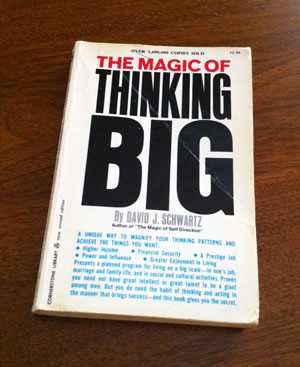 Right now I am re-reading The Magic of Thinking Big by David J. Schwartz. I first read this book in college at the recommendation of the wonderful JoAnn Butler, who was, not only a fabulous teacher and mentor, but also the person I worked for as her secretary while I was in college.
The book is about improving your attitude and thinking patterns. This book was a great book to read in college. In fact, the actual book I am reading right now is my husband, Joe B.’s, copy from when he was in college. The cover is creased and the pages are yellowing but it is still a great book to read 25 years later. Twenty-five years of life will really put a different perspective on how you view everything.
Many business owners could benefit from reading such books. When you are in business, it can be very easy to get caught up in the everyday business of running a business and forget about the goals and dreams we had when we first started. As one person put it, sometimes “life is just so life-y.”
In tumultuous times such as we are experiencing today, don’t forget your goals and dreams, and remember to THINK BIG!
by blogmistress on June 4, 2012
 The internet has dramatically changed how businesses connect and interact with their customers. The possibilities are growing exponentially. Websites used to be static brochures, now they are often interactive and ever changing. We can now add information more easily than ever before. In addition to the changes to how we can connect through our websites, we now have social media to add to the mix. We can now connect through Facebook, LinkedIn, Twitter, Pinterest and many more.
Businesses can spend untold amounts of money and time building their online presence, but what are they getting for it? What is their ROI? ROI = Return on Investment. It is important that businesses invest in what works, and smart businesses measure to see what is working. They use analytics to track sources of traffic. They use tracking codes for links to see how effective they are. They utilize calls to action and measure how effective they are at converting traffic into leads.
If your business is spending time and money on your internet presence but don’t know what your ROI is, you are missing half of the equation. And, the half you are missing could make a difference between success and failure.
Make sure you have an analytics program in place and that you have set relevant, measurable goals for success. Here are some of the metrics you should be measuring:
- Website Grade: How well optimized is your website overall?
- Traffic: Overall, how many people are coming to your website?
- Leads: How much of this traffic are you converting into leads (e.g. potential customers)?
- Customers: How many sales did you close this month?
- Customer Acquisition Cost: How much are you investing to draw in each new customer?
- New vs. Repeat Visitors: Of your overall traffic, how many visitors are returning to your site, and how many new people are finding you?
- Effectiveness by Channel: What promotional channels or referring sources are sending you the most traffic?
- Traffic by Keywords: Which keywords are drawing in the most visitors to your site?
Steps for Improvement
The following are some elements of your website you can refine so you can reach your broader goals:
- Keywords: Try new keywords or variations of keywords to see if they help you get found better.
- On-Page SEO: See if changing a simple on-page factor can help boost visits.
- Conversions: Try new things with your conversion forms or landing pages.
- Content Strategy: Determine which content is generating the most traffic.
- Social Media Promotions: Evaluate which social media channels are generating the most site visitors and leads.
- Lead Nurturing: Maybe you’re sending emails too frequently — or not frequently enough.
The key is to always keep experimenting and testing.

by blogmistress on February 8, 2012
 SEO (search engine optimization) is the next step in our internet marketing strategy. If you are following along as we go through the steps included in the Essential Guide to Internet Marketing, you will remember that the first step was researching keywords. Now that you have identified some good keywords, what should you do with them?
Keywords can help your site get found by search engines and that is what SEO is all about. SEO can be broken down into two categories:
On-page SEO – This refers to the way your content is presented to search engines and how your keywords are used on your site. This is something that you can improve immediately.
Off-page SEO – This refers to the authority your site has on the web. This can take some time to improve.
Even though on-page SEO accounts for less in how search engines rank your site. It is a good idea to correct this first because it can be improved quickly and keyword placement is an essential part of on-page SEO.
Where should you place your keywords for good on-page SEO?
- Page Title – Page titles are the text you see at the top of your browser when you are on a web page. A page title can be edited in your site’s HTML. Be sure to include the keywords for your page in the page title. Your page title should be less than 70 characters and your keywords should be at the first of the title. Each page on your site gives you an opportunity to target different keywords that are relevant to your business and to your site’s visitors.
- Meta Description – While your page’s meta description does not directly influence your search engine rankings, it is still a good opportunity to include your keywords to help you attract visitors to your site. Your meta description is a summary of what your page is about. It is not seen on your page, but is shown by search engines when your site is included in search results.
- Headings – The text that is included in your headings (those that are surrounded by <Hx> tags in the html code) are seen by search engines as being important. Be sure to include your keywords in your headings.
- Images – Images can certainly enhance your visitors’ experience on your website. Images also give you an opportunity to use your keywords. You can use your keywords in your image file names as well as the images’ alt text. Don’t use images excessively because it can slow down the amount of time it takes your page to load which can negatively impact your search results.
As important as keywords are, it is also important that you don’t “keyword stuff.” That is, don’t just fill a page with your keywords. Not only will keyword stuffing make for a bad experience for your visitors, search engines can detect keyword stuffing and it can adversely affect your rankings. Trying to “trick” search engines is not a good SEO strategy.
To get more in-depth information about how to use your keywords effectively for SEO, (both on-page and off-page), download the Essential Guide to Internet Marketing. This guide will give you the essential steps you need to set up and implement a successful internet marketing strategy.

by blogmistress on January 3, 2012
Being an entrepreneur is not for everyone. It requires a certain tolerance for risk taking. It requires a level of confidence in what you can accomplish. It requires tenacity when things get tough – when success takes more hours, more effort, more knowledge. It takes an ability to get things done with NO EXCUSES!
What excuses are holding you back?
- Not enough time – The fact is, people make time for what is important. They do what they want to do. You are not serious if you don’t have time to work on your business, but you find time to watch football games, go fishing, go shopping . . . You get the point. Sometimes, doing what it takes to grow your business is not the most pleasant thing you can be doing, but it is what needs to be done anyway. Are you committed? Just do it!
- Need more knowledge – Many people start their businesses before they are “experts”, but are very successful because they make learning what they need to know a priority. Just because you can bake great cookies doesn’t mean you will be a successful cookie business. You have to learn what you need to know about management, accounting, inventory, etc. Yes, there is a lot to learn, but if you wait until you know everything, you’ll never get started.
- Fear of rejection/failure – No one wants rejection. No one wants to fail. However, when you look at many successful entrepreneurs, they have been rejected many times, they have failed many times. The difference is, they adjust and keep moving forward. They don’t look for someone to blame. They understand that their success doesn’t depend on others. Failure and rejection are often an important part of success.
- Fear of success – People actually do fear success and success does bring it’s own challenges. What about success do you fear? Visualize success and how you will deal with the challenges and keep moving forward!
- Waiting for the right circumstances – If you are waiting for the perfect circumstances to get started, you may never start. You certainly should be aware of risks, but understand that no new business venture is without risks.
What excuse is holding you back. It’s a new year and time for new beginnings. 2012 – No Excuses! What do you think?
by blogmistress on October 14, 2011
 Every page on your site should have a call to action. Earlier this week, I posted about what every webpage on your site should have, and the call to action was one of the things I mentioned. I also talked about having a menu on every page except landing pages (where your calls to action lead). So, let’s discuss that just a little bit more in detail.
A call to action is what you ask your visitors to do when they get to your site. If you want to measure the effectiveness of your call to action, you really need it to be along the lines of a download of some type of information or a request for more information. Something that requires your visitor to give you an email or other information is much more measurable than, for instance, requesting that your visitors call you.
Once your visitor decides to act on your call to action, they should be directed towards a landing page. A landing page is where they will fill out a form in order to get whatever it is you are offering. This page is the only type of page on your website that does not need a menu. In fact, once your visitor is on your landing page, you don’t want to give them any reason to leave without taking action. Studies show that the fewer distractions on the page, (in this case a menu) the better the conversion rate.
So, what should be on the landing page? Your landing page should include clear, easy to understand, information about what your offer is – what they will get when they fill out your form. Putting this information in a bulleted list will make it easy to read. Of course, your landing page should also contain your form. Your form should ask for the right amount of information. Think about your sales funnel. If your offer is a top of the funnel offer, you should ask for less information than you would for a bottom of the funnel offer. Finally, your landing page could also include a picture that will support your offer.
It is important to get your landing pages right. The difference between an effective landing page and an ineffective landing page is the number of conversions (or actions) that are made on that page. Everyone who converts on a landing page is now a lead for your business. Leads are people who have needed what you have offered and have taken the action to get the offer. Test out different landing pages to see what works better and what doesn’t. Place your calls to action in different places on your site and posts to see what difference that might make.
Inbound marketing with calls to action and landing pages works. Give it a try.
by Admin on September 9, 2011
Does your product or service offer something different from your competition’s? I mean, besides the fact that you do it better than your competition.
When the iPhone first came out, I wanted one for the simple reason that when I wanted to hear my messages, it allowed me to select the message I wanted to hear. I didn’t have to listen to five messages before I got to the one I really needed to hear. I get a lot of calls when I am in meetings and people leave me messages – some more important than others. Usually, the less important the message, the longer the message. It always seemed that to get to the important message, I had to listen to five minutes of less important messages. So the iPhone was a game changer for me and I was willing to pay the price.
Is your product or service a game changer for your customers? Are your customers looking for a game changer? I am sure there are a lot of cell phone users who couldn’t care less about the iPhone’s messaging feature, or if they did, the feature was not enough to justify the price for them.
Seth Godin says:
People looking for ‘more of the same’ aren’t actively looking. While there may be a lot of them, they’re satisfied with what they’ve got, which means they’re hard to attract. No, the real opportunity is in reaching out to the dissatisfied, to those in search of something new.
Does your product or service offer something new or is it just more of the same?

by Admin on August 31, 2011
 Is your website a traditional advertisement for your business or something more?
About.com defines advertising as
the paid, public, non-personal announcement of a persuasive message by an identified sponsor; the non-personal presentation or promotion by a firm of its products to its existing and potential customers.
That sounds like a lot of websites we see. Websites are paid, public promotions by firms of their products to their existing and potential customers. But where websites can and should differ from traditional advertising is websites can be personal. It is possible to have a personal interaction on a website.
Traditional advertising is what we refer to as “outbound” or “interruption” marketing. The traditional advertisement has to interrupt you and gain your attention before it tries to promote its products or services. That’s why we see and hear so many goofy ads. They are trying to gain your attention through silliness.
Websites are examples of “inbound” or “attraction” marketing. Websites are found by people searching for the information they contain. Websites can increase their “attraction” or likelihood of being found by increasing the amount information on them that people are searching for. One of the best ways to do this is through a blog. Each blog post gives your website a new opportunity to be found.
So don’t look at your website as an advertisement. It can and should be so much more. Don’t waste your money or your visitors’ time with silly gimmicks to gain their attention. You already have their attention. Remember they were looking for information and found your website in the process. Give them the information they are looking for.
Make your website a lead generating machine. Let us show you how.

by blogmistress on August 30, 2011
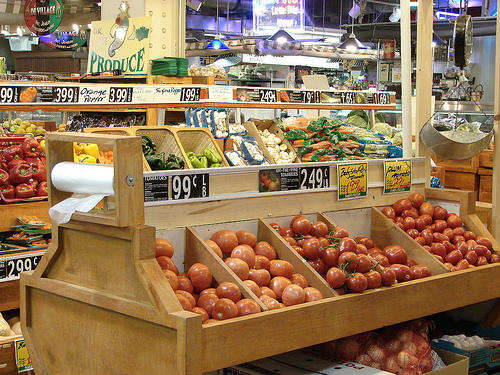 You may have noticed, many grocery stores have similar layouts. The dairy and meat departments tend to be at the back of the store. You have to walk past a lot of other enticing items to get to those mainstay departments. Staple items like salt and flour are usually on lower shelves. Specialty spice blends are placed at eye level. That makes it easier for those items to capture your attention and hopefully go in your cart.
Contrary to what you may have heard, grocery stores don’t do this to trick you, they do it to stay in business. It’s called marketing and it works. Grocery stores typically run on a pretty narrow profit margin so they use everything they can, including layout and design to make it easier for you to buy more.
We can use the same principles in our online marketing efforts. A grocery store wants to “introduce” you to items that you might buy while you are on your way to items you were going to buy anyway. Online, things are different. People are impatient. They want to find things quickly. So, while we can use layout and design to help our marketing efforts, it will be in a very different way.
You may have noticed that, like grocery stores, many websites have similar layouts. Navigation at the top or down the side. Often the navigation will include drop downs or flyouts to make it easier to get where you want to go in fewer clicks. There may also be sidebars where you can find a compelling call to action. The reason so many businesses use similar layouts is the same reason so many grocery stores have similar layouts. It’s called marketing and it works.
There are companies who specialize in grocery store layout. They create layouts and designs that will market products effectively. This gives the grocer a better chance at making a profit and staying in business. There are also companies (like Wharton Marketing) that specialize in web design for effective marketing. Good design gives businesses a better chance at being successful and growing their business.
Look at your own website. How easy is it for visitors to find what they are looking for? How many clicks does it take? Don’t just use your own experience. Get someone outside of your business to try it out. How easily is your site viewed on mobile? What works well and what doesn’t work? Take a lesson from your favorite grocery store and make it easy for people to buy more!
by blogmistress on August 19, 2011
Okay, after a week full of internet marketing information, it is time for a little inspiration:
Watch your thoughts, they become words.
Watch your words, they become actions.
Watch your actions, they become habits.
Watch your habits, they become character.
Watch your character, it becomes your destiny
~Motto, Metropolitan Milwaukee YMCA
Let’s watch it today and be awesome!
by blogmistress on August 12, 2011
Thought for the day:
Do a little more than you’re paid to.
Give a little more than you have to.
Try a little harder than you want to.
Aim a little higher than you think possible,
and give a lot of thanks to God
for health, family and friends.
~Art Linkletter
Be awesome today!




